
Theory and Practice by FOSHAN JINHAOTAI LIGHTING ACCESSORIES CO., LTD
Abstract
This paper aims to analyze the advantages of aluminum as a conductor in terms of price and conductivity, specifically in comparison to brass. By comparing the conductivity and cost of these two materials, we will demonstrate the superiority of aluminum in the production of electrical conductors.
Introduction
Choosing the right material is crucial in the production of electrical conductors. Aluminum and brass are common conductor materials, but they differ significantly in terms of conductivity and cost. This paper will analyze the characteristics of these two materials in detail to prove the advantages of aluminum in electrical conductor production.
Comparison of Material Properties
| Material | Conductivity (% IACS) | Density (g/cm³) | Cost (USD/kg) |
|----------|------------------------|-----------------|---------------|
| Aluminum | 61 | 2.70 | 4.20 |
| Brass | 28-37 | 8.50 | 8.20 |
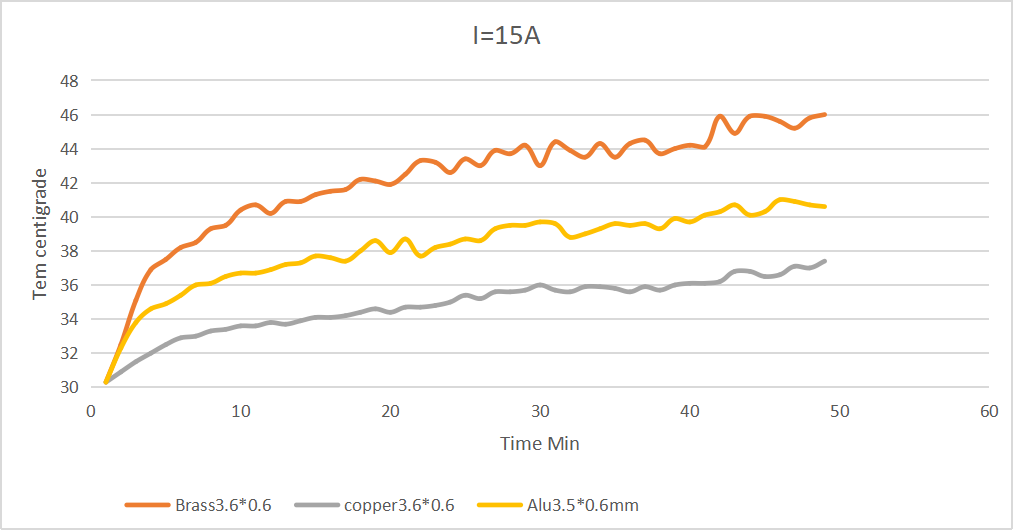
The following are temperature comparison experimental graphs of three conductors with the same cross-sectional area of 3.6 * 0.6mm, namely purple copper, aluminum wire, and brass, under the same current conditions. Room temperature in 30°C.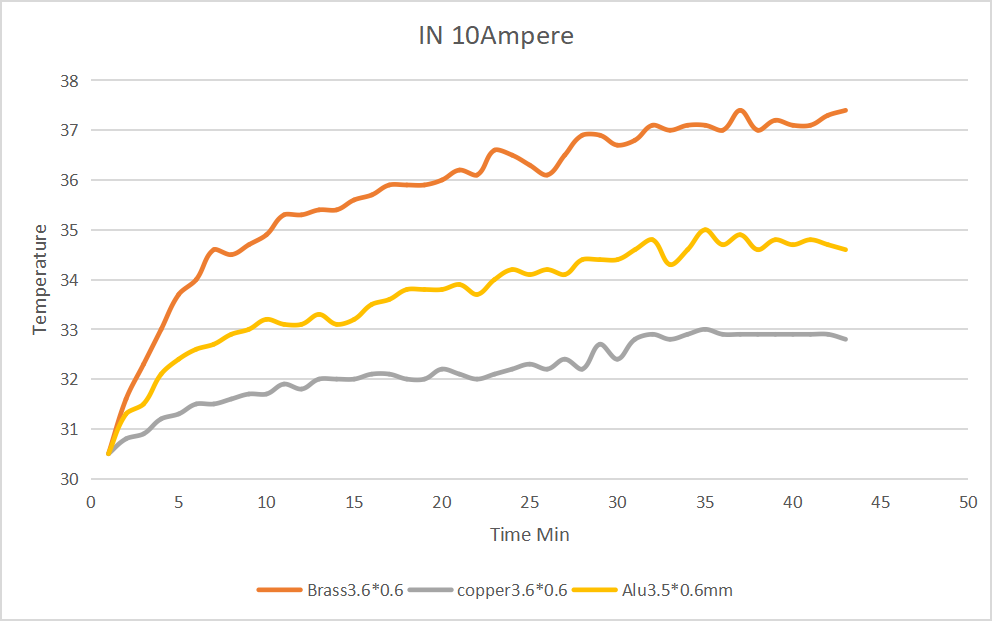
Conductivity Analysis
The conductivity of aluminum is about 61% IACS (International Annealed Copper Standard), while the conductivity of brass is only 28% to 37% IACS. This shows that aluminum has significantly higher conductivity than brass. Additionally, aluminum has a density of only 2.70 g/cm³, compared to brass's 8.50 g/cm³, meaning that aluminum is lighter in weight for the same volume, which helps reduce the overall weight of electrical conductors.
Cost Analysis
From a cost perspective, aluminum is priced at approximately 4.20 USD/kg, while brass is priced at around 8.20 USD/kg. The cost of aluminum is only one-third that of brass, In conductors of the same cross-section, the price of aluminum wire is only 16% of that of brass,making aluminum significantly more economical for large-scale production.
Price Comparison for Equal Cross-Sectional Area
When comparing the cost of aluminum and brass conductors with the same cross-sectional area, aluminum remains the more cost-effective option. Given that aluminum is lighter and has higher conductivity, less material is needed to achieve the same electrical performance. This further reduces the overall cost of using aluminum compared to brass.
Future Design
We can make an assumption that since aluminum wire is 12% of the price of copper and 16% of brass at the same cross-section, we can increase the size of the aluminum wire to achieve the conductivity of copper conductor. In our company's plan, as long as the cross-sectional area of the aluminum wire is 140% of the cross-sectional area of copper, we can achieve the desired effect, which is a balance between conductivity and cost. At that time, the cost of aluminum wire will only be 17% of that of copper
Conclusion
In summary, aluminum as a conductor is superior to brass in terms of both conductivity and cost. Aluminum not only has higher conductivity but is also cheaper and lighter, making it suitable for large-scale production of electrical conductors. Therefore, choosing aluminum as a conductor material will bring significant economic and performance advantages to the company.
